
Your needs, this model
Does it fit your priorities?
Can one A-88MKII setup use a USB-C computer and a separate MIDI instrument?
Roland's manual describes three zones, each assignable to USB MIDI or the physical MIDI OUT. A setup can keep one zone on USB-C computer MIDI and direct another zone through the five-pin DIN output to an external instrument. This is a routing configuration, not a guarantee that every zone is duplicated to both outputs. The computer powers USB operation; an external-only arrangement needs the separately sold PSB-1U or another manufacturer-supported power route.
Explore this need in the finder →Does the A-88MKII produce the piano or synthesizer sound itself?
No built-in sound generator or audio output is specified. It sends playing and controller data over USB MIDI or MIDI DIN, so the sound must come from a computer instrument or external sound module and then reach speakers/headphones through that source's audio output. MIDI cables are not audio cables.
Explore this need in the finder →What should I verify before expecting MIDI 2.0?
Roland ties the A-88MKII's MIDI 2.0 support to system software Version 2.00 and later; the US download section lists Ver. 2.12 as the current program on the checked date. Check the firmware on the specific unit and the receiving app or instrument's MIDI 2.0 support. The feature is not established by the model name alone, and no update was performed for this assessment.
Explore this need in the finder →An 88-note controller with a piano-derived mechanism
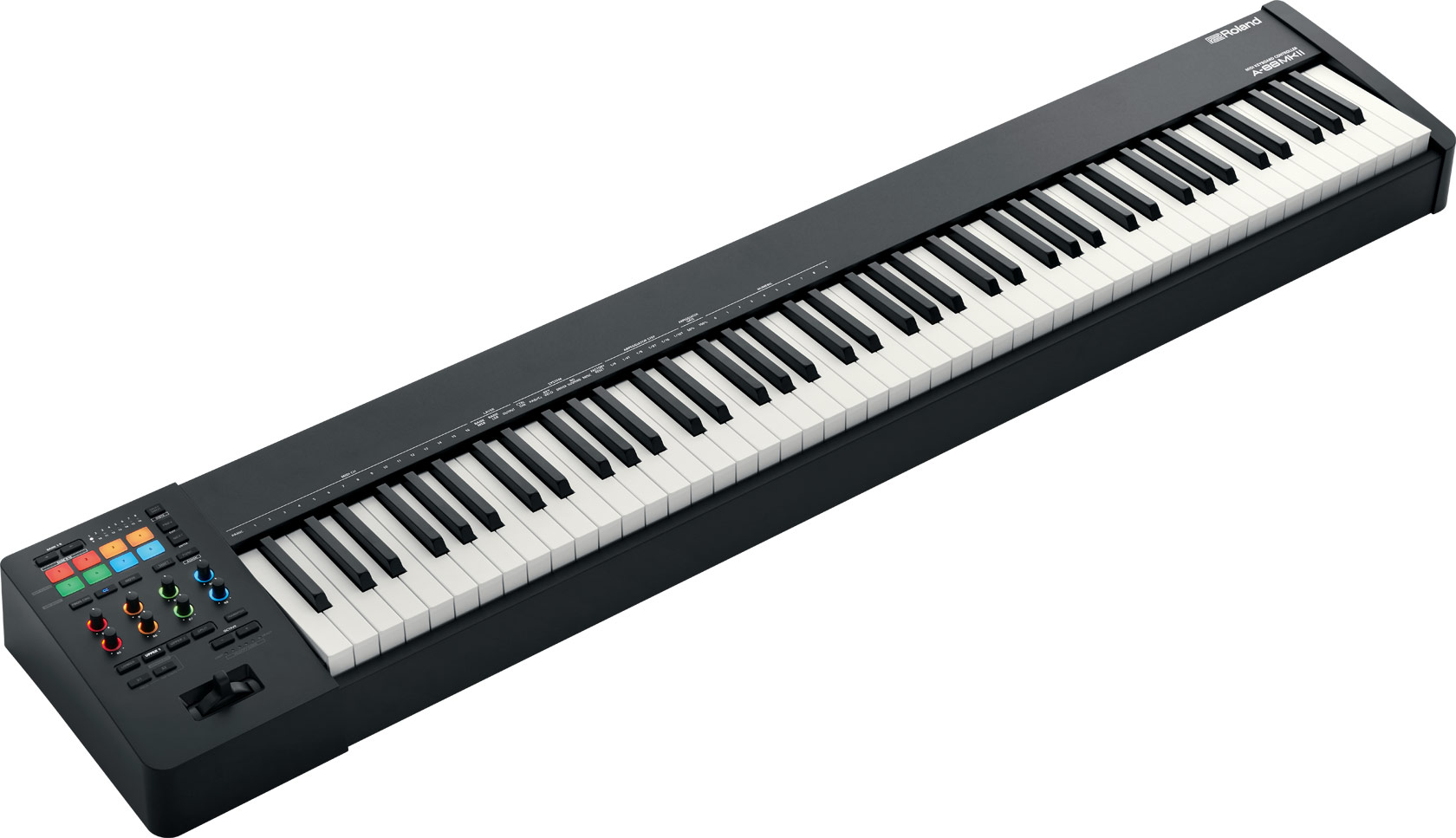
Roland's A-88MKII is a full-range MIDI controller rather than a stage piano with onboard speakers. Its US product page lists 88 keys in a PHA-4 Standard bed with escapement and Ivory Feel, and describes hammer action. Those details make it a plausible candidate for players who need a full piano-like span from a separate sound source, but they do not establish a tactile preference or a measured performance result. This review is a source-based assessment of Roland's specification and English owner's manual, not a personal playing test.
The 88 notes eliminate octave switching for passages that exceed a shorter controller's range, but the size is consequential. Roland publishes a 56-5/16-inch width, 10-13/16-inch depth and 4-11/16-inch height, at 17.5 kg (38 lb 10 oz). The length alone can dominate a compact desk; the mass also deserves a suitable support surface and careful lifting. The quoted dimensions describe the chassis, not a stand's capacity or room for a USB lead, MIDI plug, pedal wiring, hands or adjacent gear. Add those margins to your actual layout before treating a numeric width pass as a fit decision.
Zones and controls reward deliberate setup
The control surface adds eight assignable illuminated pads, eight assignable illuminated knobs, two assignable buttons and a pitch/modulation lever. The A-88MKII also has three user-definable zones, an onboard arpeggiator, chord memory and eight user memories. That combination is more flexible than a bare controller, especially if you switch between a computer instrument and external hardware. The manual explains that each zone can be routed to USB MIDI or the physical MIDI OUT. A useful split plan is to send one zone to the computer and another to a DIN-connected module; it is not the same as assuming every note is duplicated across both ports automatically.
Roland does not specify pressure sensitivity or velocity sensitivity for the eight pads in the pages reviewed, so those properties remain unknown. The manual's MIDI implementation chart also marks keyboard key and channel aftertouch unsupported. A pad bank, a piano-style keybed and pressure reporting are separate traits; do not buy this model on the assumption that either the keys or pads offer a pressure response the source does not document.
USB-C, DIN and the sound path
The rear panel provides USB Type-C plus physical MIDI IN and MIDI OUT. Roland's manual describes USB computer MIDI in its generic driver mode without requiring driver installation, and the specification lists power supplied from the computer through USB. Roland includes both a USB-C-to-USB-C cable and a USB-C-to-USB-A cable in its published package list. Use a data-capable lead and verify the exact host and adapter; the product page's iOS/iPadOS compatibility note distinguishes Lightning-equipped devices, which need an adapter and cannot use USB bus power in that connection. A separately sold PSB-1U AC adaptor is an option, not a listed included item.
External MIDI is equally distinct from audio. The DIN connection can send performance data to a module, but the module must generate the sound and connect to an audio monitoring system. When the computer is the instrument, the host application produces sound through the computer's audio route. Roland lists no sound engine or audio output on the A-88MKII. This distinction keeps a multi-port setup honest: USB MIDI and five-pin DIN are controller data paths, not a built-in piano signal or an audio interface.
One software detail has a version boundary. Roland says MIDI 2.0 support is available with A-88MKII system software Version 2.00 and later; the US downloads section listed Ver. 2.12 on the date checked for this review. That is evidence for an update path, not proof that a used board already has a qualifying version or that every receiving instrument and app supports MIDI 2.0. Check the unit's firmware and the host before relying on higher-resolution expression. The controller's MIDI 2.0 capability is therefore conditional on the larger setup, not just the model name.
Who should shortlist it—and what should be verified
The strongest documented case is a desk or studio where the 88-key range is necessary, USB-C host control matters, and a separate DIN module or multi-zone arrangement is useful. The PHA-4 bed, three zones, arpeggiator and control bank give more than a simple note-only keyboard, while the class-compliant generic USB mode avoids the A-49's documented driver step. The trade-off is a long, heavy chassis and external dependencies for sound, audio monitoring, pedals and an AC power route if the computer is not supplying USB power. The eight pads are not a verified pressure-pad alternative.
Confirm the exact A-88MKII name and 88-key model label, current physical condition, firmware version, included USB cables, any separately sold adapter or pedals, software compatibility and the seller's return terms. Check that a stand or desk supports the real load and spans the instrument safely; the published weight is not stand approval. Reserve room behind the controller for cables, and test a DAW/module routing plan in Roland's control software before a performance. No SKU, seller package, price, stock, rating or warranty term is claimed here. The model merits consideration for a full-range, expressive controller setup, but not as a self-contained piano or as a promise of unverified pad pressure, MIDI 2.0 firmware or universal software behavior.
Key specifications
Key details at a glance
| Keys | 88 |
|---|---|
| Manufacturer's keybed description | Weighted hammer action (Roland PHA-4 Standard) |
| Width | 56.31 in |
| Pads | 8 |
| 5-pin MIDI Out | Yes |
| Computer connection | USB-C |
| USB bus-powered | Yes |
| Assignable pedal input | Yes |
| Keyboard channel aftertouch | No |
| 5-pin MIDI In | Yes |
| Depth | 10.81 in |
| 5-pin MIDI outputs | 1 |
Use the exact model’s instructions for operating limits, supplied equipment and version differences.
Sources for this review
Sources for this assessment
Start with your setup, not a headline feature
Use the finder to combine key-count, connection, control and desk-fit requirements. Unverified specifications are never treated as a match.