
Your needs, this model
Does it fit your priorities?
Does the MPK Mini Plus fit a compact 37-key hardware-control setup?
Akai lists 37 mini keys, an internal two-track step/live sequencer, USB Type-B, five-pin MIDI In/Out and three CV outputs. Its published body width is 17.76 inches. That is a body-only screen: allow extra desk space for the USB, DIN, sustain and CV/Clock leads, and confirm whether your intended MIDI path uses bus power or a separate wall adapter.
Explore this need in the finder →Will the MPK Mini Plus satisfy a USB-C computer-port requirement?
No. The exact MPK Mini Plus technical specification names a USB Type-B port, and Akai's FAQ describes a USB-A-to-USB-B cable; a USB-C host may need the right cable or adapter. Do not treat the newer Plus II's USB-C connector as a specification for this distinct model.
Explore this need in the finder →Can the MPK Mini Plus play sound by itself when connected to MIDI gear?
The model FAQ identifies it as a USB-MIDI controller rather than a self-sounding instrument. Its sequencer, DIN ports and CV outputs send control signals; a receiving synthesizer or software instrument must generate sound, and you must arrange separate audio monitoring. Akai's DIN setup guide also distinguishes a computer-powered MIDI-interface route from the separately wall-powered route.
Explore this need in the finder →The MPK Mini Plus sits between a compact pad-and-key controller and a small hardware-routing center. Akai lists 37 mini keys, a two-track step/live sequencer, eight pads, USB Type-B, five-pin MIDI In/Out, three CV outputs and CV Clock In/Out. Those features make the model distinct from the 25-key MPK Minis, but the connector and audio details matter more than its feature count: this is a MIDI controller, not an instrument with its own sound engine.
Thirty-seven mini keys widen the working range
Three octaves offer more adjacent notes than the 25-key MPK Mini MK3 or MPK Mini Play MK3. Akai describes the bed as its Gen 2 Dynamic Keybed and says it is velocity-sensitive. That establishes a note-response feature, not a measured feel, full-size key spacing or suitability for a particular hand span. A 37-key minimum in the finder is a range screen; it cannot predict whether the mini-key format will suit a player's repertoire.
For a desk already organized around a laptop and external instruments, the extra octave can reduce how often a player needs to shift the keyboard's octave setting during a phrase. It still falls well short of a 49-, 61- or 88-note controller when wide two-hand parts are central. If full-size keys or a longer range are the priority, compare it with the Launchkey 37 MK4 or larger assessments instead of treating note count as a ranking.
The two-track sequencer is a workflow feature, not a speaker
Akai describes an onboard two-track step/live sequencer and says patterns can be sent to a DAW or compatible hardware. The documented workflow is useful when a player wants to enter or perform note and rhythm patterns from the controller, but the fact sheet does not document onboard audio generation. The sequencer can send control data; a software instrument or receiving synthesizer must make the sound, and an audio interface, headphone output or other monitoring path must still be planned.
This difference matters if “standalone” means playing audible notes without a computer. The MPK Mini Plus is not the sound-producing option in this group. Akai lists USB bus power or a wall adapter, and its setup article explains that the DIN ports behave as an external MIDI interface with a computer or transmit performance MIDI when wall-powered. The adapter's inclusion in a seller's package was not established, so check the listing and manual before building a computer-free rig around it.
USB Type-B, DIN and CV/Clock serve different jobs
The computer connection is a USB Type-B port, not USB-C. A modern laptop with only USB-C may need a compatible cable or adapter, and the host still has to recognize the MIDI interface. Akai's model FAQ describes class-compliant USB operation; it also describes the device as a MIDI keyboard rather than a sound generator. The physical MIDI ports are separate five-pin DIN In and Out. When the controller is powered by a computer, Akai says the DIN ports can operate as a MIDI interface selected in the DAW. Its external-device instructions describe a wall-powered route where MIDI Out transmits by default.
Three 1/8-inch CV outputs labeled Pitch, Gate and Mod plus CV Clock In/Out are another path again. Those analog control-voltage and clock connections are for compatible modular or analog equipment, not a replacement for USB audio, DIN MIDI, or a standard headphone output. The receiving equipment, correct 1/8-inch TS cables, power and monitoring remain separate considerations. The exact model FAQ explains that CV/Gate outputs can be configured, while the specific destination's voltage expectations must be checked against its manual.
The body is compact, but the whole hookup is wider
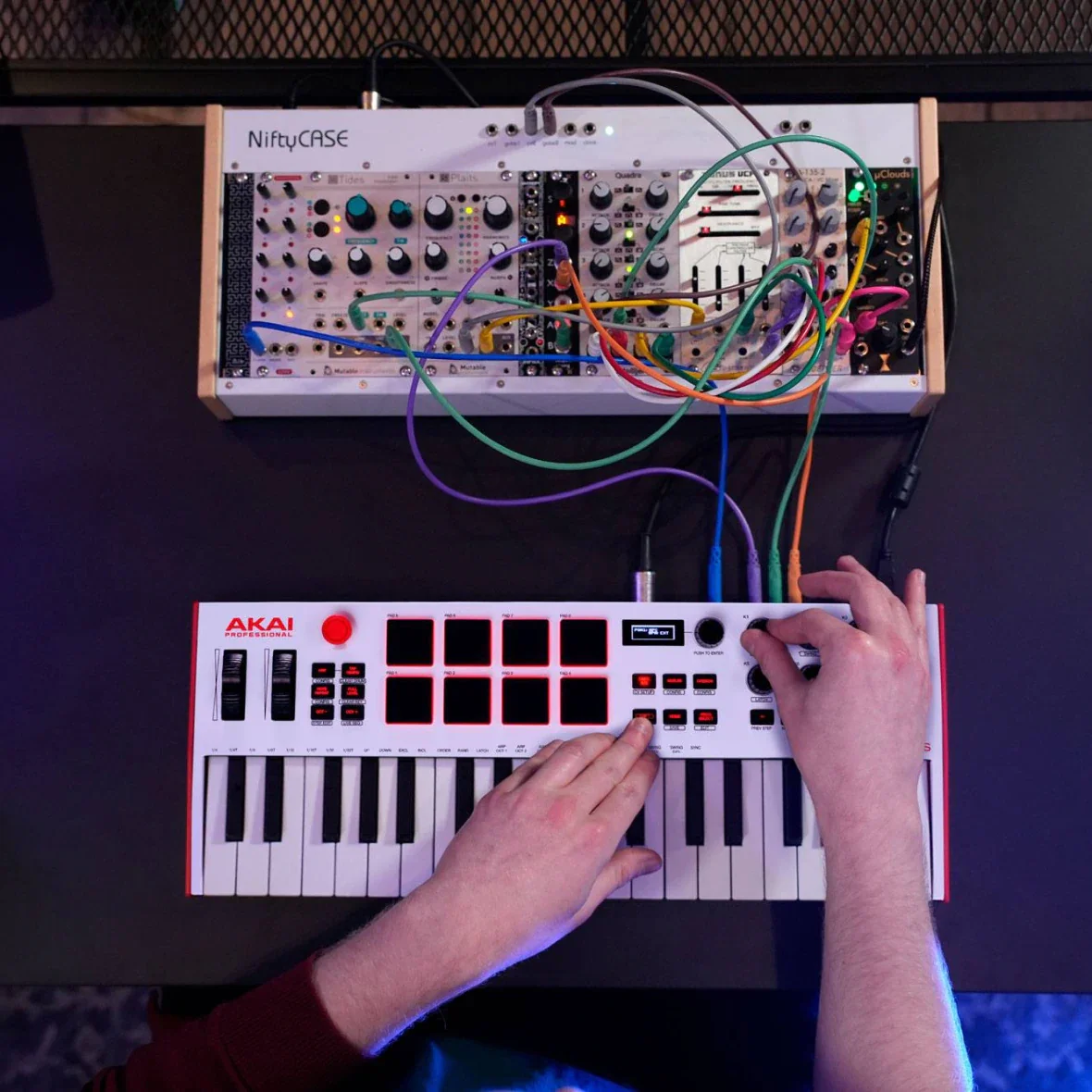
Akai publishes a 17.76-by-7.08-by-2.04-inch body and a 2.78-pound weight. The 17.76-inch width can help screen a narrow desk, but it is only the controller's chassis. USB-B, sustain, DIN and CV/Clock plugs can extend beyond the case, and a cable bend, hands and adjacent equipment need room. The photographed modular rack and cables on Akai's product page illustrate a possible use; they are not claims about included accessories.
Akai describes eight pads as velocity-sensitive. The exact product-page specification does not state pressure sensitivity, so this assessment leaves that field unknown rather than transferring the MPK Mini MK3's pressure-pad wording to the Plus. If pressure-sensitive pads are essential, use a model whose own specification confirms them. The page also does not establish keyboard-key aftertouch, and the product FAQ's dimensions answer contains a model-name typo; the exact product page itself supplies the 17.76-inch dimensions used here.
Choose it for its particular ports, not its family name
The MPK Mini Plus is a current Akai collection reference, distinct from both the shorter 25-key Mini MK3 and the 37-key MPK Mini Plus II. The Plus II's own product page and FAQ identify a different connector/control arrangement; the original Plus's Type-B connection, DIN In/Out and sequencer should not be carried over to that later model. Conversely, the Plus II's USB-C connection should not be assumed here.
Consider the Mini Plus when 37 mini keys, a sequencer and direct access to both DIN and CV/Clock gear are part of the actual setup. Choose another model if USB-C is a hard requirement, if the keyboard itself must produce sound, or if a full-size keybed or confirmed pressure-sensitive pads are essential. There is no basis here for a price, stock, tested-feel or durability claim; confirm the exact seller model, cable, adapter and return terms before purchase.
Key specifications
Key details at a glance
| Keys | 37 |
|---|---|
| Manufacturer's keybed description | Velocity sensitive mini keys |
| Width | 17.76 in |
| Pads | 8 |
| Velocity-sensitive pads | Yes |
| 5-pin MIDI Out | Yes |
| Computer connection | Usb-b |
| USB bus-powered | Yes |
| Assignable pedal input | Yes |
| 5-pin MIDI In | Yes |
| Depth | 7.08 in |
| 5-pin MIDI outputs | 1 |
Use the exact model’s instructions for operating limits, supplied equipment and version differences.
Sources for this review
Sources for this assessment
Start with your setup, not a headline feature
Use the finder to combine key-count, connection, control and desk-fit requirements. Unverified specifications are never treated as a match.