
Your needs, this model
Does it fit your priorities?
Does the original V49 meet a 49-key physical minimum?
Yes. The exact V49 product page says 49 full-size keys and its matching user guide describes a 49-note keybed. Octave Up/Down repositions the range; it does not turn the physical keyboard into a 127-key instrument.
Explore this need in the finder →Are the V49's pads documented as pressure-sensitive?
Alesis lists eight velocity- and pressure-sensitive pads on the exact V49 page. The v1.2 manual details velocity response and MIDI assignments but does not identify a polyphonic-aftertouch mode. This pad feature should not be confused with channel aftertouch on keys, which is not specified.
Explore this need in the finder →Can the V49 send MIDI directly to an external five-pin DIN instrument?
The exact V49 manual maps USB to the computer and a 1/4-inch TS sustain input; it does not list a five-pin MIDI socket. This assessment therefore does not count a direct DIN route. A USB host or separate MIDI interface would be an additional device, and MIDI alone does not provide audio.
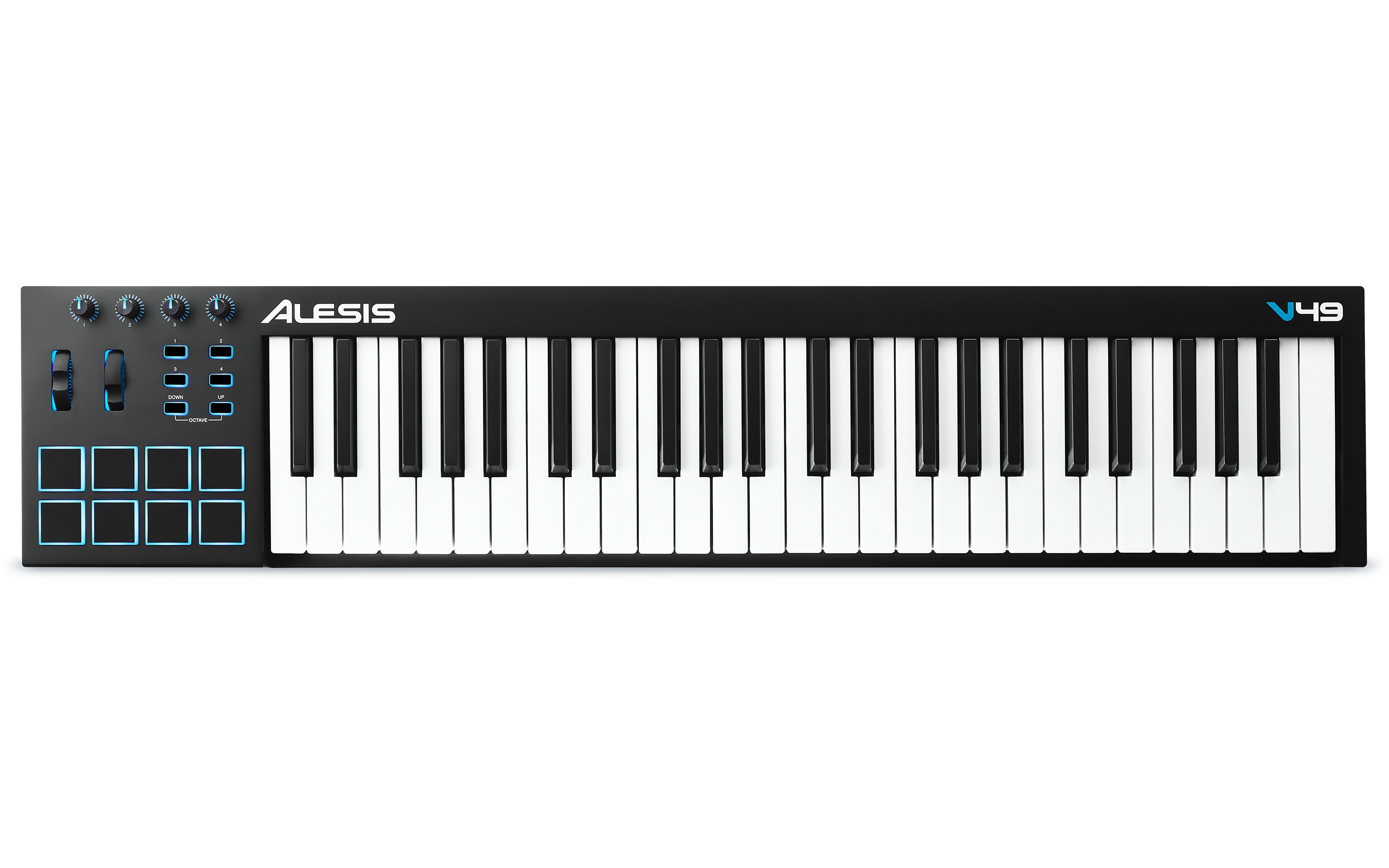
Explore this need in the finder →The original Alesis V49 is an earlier 49-key USB-MIDI controller with a different documented feature set from the V49 MKII. It has a longer physical key span than the V25, while retaining eight velocity- and pressure-sensitive pads, four assignable knobs, four assignable buttons, pitch/modulation wheels and an optional sustain-pedal input. Its assessed connection is USB to a computer; a direct five-pin MIDI output, body measurements and the MKII feature set are not established here.
A middle-length keybed, not an 88-key substitute
Alesis identifies 49 full-size, velocity-sensitive keys on the exact V49 page, and the matching v1.2 guide describes the same 49-note keybed. The Octave Up/Down buttons shift the note range so you can reach notes outside the current span, but still leave only 49 physical keys available at once. That can be a useful compromise for two-handed parts, left-hand bass with right-hand chords, or a central studio keyboard that should not occupy a full-width piano stand. If broader physical reach is a routine need, the original V61 is a separate 61-key configuration; for a shorter physical span, the original V25 is not the same key-count fit.
The page says “full-size” and “velocity-sensitive,” but neither the exact page nor the v1.2 guide calls the key action synth, semi-weighted or weighted. The inspected sources do not publish the V49's key width, action weight, chassis width/depth/height or mass; they also do not establish keyboard-key aftertouch. Thus 49 keys may answer a range requirement, but not a strict tray-fit, key action or measured-dimension requirement. Measure an exact unit if the usable desk opening is small and leave room for the hands and rear cable path.
Eight pads and a small assignable panel
The original V49's feature list has eight backlit pads, four assignable knobs and four assignable buttons. The page says the pads are velocity- and pressure-sensitive. The matching manual explains velocity response and their assignment options, including MIDI CC or Program Change messages, but does not specify a polyphonic-aftertouch mode. It also does not describe pressure response on the keyboard keys. A trigger pad's pressure feature should not be read as keyboard aftertouch, nor as a particular DAW's preset mapping.
For a light software-control setup, the two wheels, knobs, buttons and octave controls can provide tactile choices beyond playing notes. The guide says the knobs send MIDI CC messages and may be set in V Editor; the buttons support momentary or toggle operation and can send CC or Program Change messages. That is a flexible but modest control count. Anyone expecting many channel faders, a large transport section, or a host-specific integration should compare the exact surface rather than infer that “USB-MIDI” means the DAW's mixer is automatically mapped.
USB-MIDI, bus power and separate audio
Alesis describes one USB computer connection for both MIDI and power. The exact guide's connection diagram shows the USB-to-computer arrangement and a separately optional sustain pedal; the rear-panel list has no five-pin MIDI socket. This makes the V49 suited to a computer-centered workflow on the documented evidence. It is not a direct DIN cable solution for a hardware sound module. A computer, USB-MIDI host or compatible interface would have to relay data to a DIN-only instrument, which still needs power and its own connection to audio monitoring.
Neither the page nor guide names the physical device-end USB plug. The files call it USB and show a standard cable, so a USB-C requirement is unresolved rather than met. Confirm the actual socket and cable supplied with a particular used unit. There is also no sound engine or audio output described: the V49 sends performance data, and a software or external instrument must make the sound.
Keep the original generation separate from V49 MKII
Alesis currently lists the V49 and V49 MKII as distinct cards in its MIDI Controllers category. The original guide reviewed here documents a 49-note, velocity-sensitive keybed, pressure-sensitive pads in the product-page feature list, assignable buttons/knobs and V Editor. It does not give the MKII's six-mode arpeggiator, transpose button or the same bundle description. The site's “earlier” designation reflects the identifiable generation split; it is not a manufacturer statement that the original page is discontinued, or proof of dealer stock.
Software descriptions deserve a separate check. The V49 product page lists Ableton Live Lite 9 and AIR Music Tech Xpand!2 downloads, whereas its v1.2 guide lists V Editor and a Software Download Card. That documentation mismatch means an individual seller's software should not be assumed current, unused or transferable. The page's listed old operating-system minimums are not a current compatibility promise. Check the exact model label, condition, cable, software entitlement and current host requirements with Alesis before you attach value to a bundle. The guide lists a sustain input, but not a sustain pedal in its box contents.
Who should shortlist the original V49?
It is worth considering when the goal is a 49-key full-size span, a simple pad-and-knob layer, USB computer MIDI and optional pedal control. It is not a supported choice for a direct DIN output requirement, a required USB-C socket, a strict published width screen or an integrated instrument/audio system. Its exact dimensions remain unknown in the sources reviewed here, so do not translate the visually longer keybed into a numeric footprint. This is a source-based review, not a hands-on test; confirm the generation, chassis fit and the seller's exact package before purchase.
Primary sources: Alesis V49 product page; Alesis V49 User Guide v1.2; Alesis MIDI Controllers category.
Key specifications
Key details at a glance
| Keys | 49 |
|---|---|
| Manufacturer's keybed description | Velocity sensitive full size keys |
| Pads | 8 |
| Velocity-sensitive pads | Yes |
| Pressure-sensitive pads | Yes |
| 5-pin MIDI Out | No |
| USB bus-powered | Yes |
| Assignable pedal input | Yes |
| 5-pin MIDI In | No |
| 5-pin MIDI outputs | 0 |
Use the exact model’s instructions for operating limits, supplied equipment and version differences.
Sources for this review
Sources for this assessment
Start with your setup, not a headline feature
Use the finder to combine key-count, connection, control and desk-fit requirements. Unverified specifications are never treated as a match.