
Your needs, this model
Does it fit your priorities?
Does the original V61 provide 61 physical keys?
Yes. Its exact product page specifies 61 full-size, velocity-sensitive keys and its matching guide calls the keyboard 61 notes. Octave Up/Down shifts note range, not the physical key count.
Explore this need in the finder →Does the V61's pad specification meet a pressure-sensitive-pad requirement?
Alesis's exact V61 feature list calls its eight backlit pads velocity- and pressure-sensitive. The user guide describes velocity-sensitive pads but does not specify polyphonic pad aftertouch, so do not infer that separate protocol or keyboard-key aftertouch.
Explore this need in the finder →Can the V61 drive a five-pin hardware synth without a computer?
The exact V61 guide's rear-panel list and connection diagram identify computer USB and an optional sustain pedal, not a five-pin MIDI port. The documented arrangement is computer USB-MIDI. Direct module use would require a separate host/interface, and the module needs its own audio/monitoring path.
Explore this need in the finder →The original Alesis V61 is a 61-key, full-size USB-MIDI controller from the earlier V generation, not the later V61 MKII. Alesis's exact page lists eight velocity- and pressure-sensitive pads plus a small assignable control surface; its V61 v1.2 guide documents a velocity-sensitive 61-note bed, wheels, USB computer connection and an optional sustain input. It is a computer-controller assessment, not a claim that this keyboard generates its own sound or sends directly to five-pin MIDI hardware.
Sixty-one physical keys without an 88-key claim
The V61's 61 physical full-size keys give more room for two-handed arrangements than the original V25 and more continuous range than the original V49. The matching guide confirms the 61-note keybed and octave buttons that extend its reach across the 127 MIDI notes. The octave buttons are useful when a part goes beyond the current area, but they do not change the physical count or create a full 88-key span. Compare the sibling reviews for their distinct physical sizes: V25 and V49.
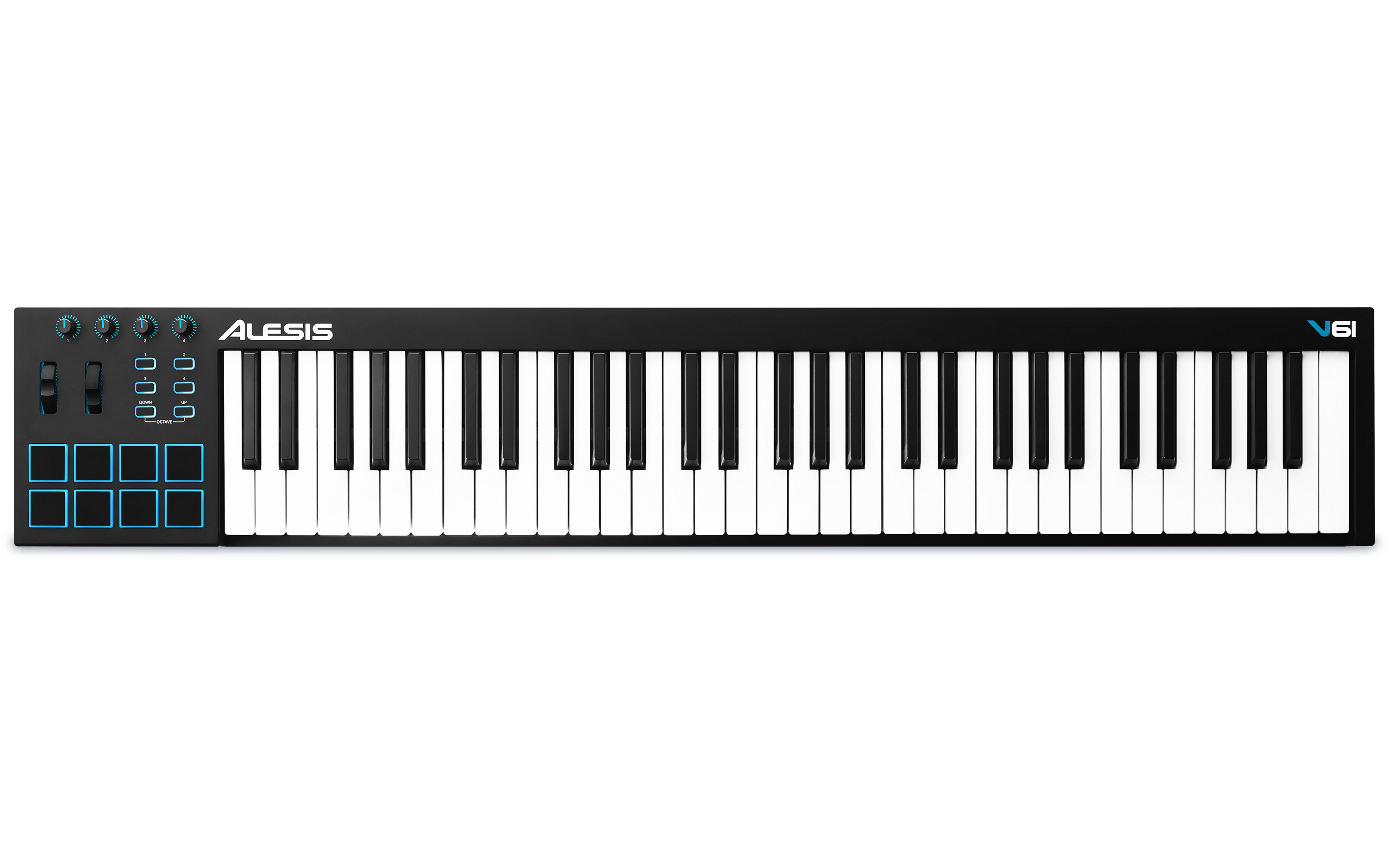
Alesis specifies full-size, velocity-sensitive keys. The reviewed original V61 page and v1.2 manual do not classify its action as synth, semi-weighted or weighted, and do not give key width or aftertouch behavior on the keybed. They also do not provide a numeric chassis width, depth, height or mass. That leaves a meaningful gap for someone with a fixed stand or a requirement for a particular action. The official V61 image confirms the printed model identity and relative 61-key configuration, but cannot be used to derive measurements or stand clearance.
What the pad-and-knob panel does—and does not say
The V61 has eight backlit pads, four assignable knobs and four assignable buttons, plus separate pitch and modulation wheels. Alesis's V61 product page calls its pads velocity- and pressure-sensitive. The guide explains velocity-sensitive pad triggering and the assignments the user may change in V Editor; it does not define polyphonic aftertouch on pads. Keyboard aftertouch is not specified either. This gives a practical pad-and-expression surface for software clips, samples or control messages, but does not establish a particular pad protocol or a built-in drum instrument.
The four knobs send MIDI CC messages and can be reassigned; the four buttons are documented for momentary/toggle behavior and MIDI CC or Program Change. Alesis describes these as controllers for software instruments and effects. This is less control-dense than a keyboard with multiple sliders, transport controls or a dedicated display, and the useful mapping depends on the chosen DAW or instrument. Consider the actual tasks—parameter tweaks, trigger pads, note entry—rather than treating any four knobs as a substitute for a full software mixer.
USB connects the controller, not the audio
The exact V61 manual shows a computer connected by USB and a separate optional sustain pedal; its rear-panel callouts do not list five-pin MIDI sockets. The exact product page describes one USB connection for MIDI and power. A direct V61-to-DIN-instrument cable therefore is not established; use a suitable computer or USB-MIDI host/interface if you need to relay notes to a hardware sound module. MIDI data does not carry the instrument's audio, so the receiving module or computer instrument still needs its own power and a separate path to headphones, speakers, mixer or interface.
The written Alesis materials specify USB but do not name the physical plug at the controller. A required USB-C socket is therefore not confirmed. Check the actual port and cable on the specific unit, especially for a used listing. No onboard sound engine or audio output is described in the sources assessed here.
Earlier V61 versus V61 MKII
The current Alesis MIDI Controllers route links both V61 and V61 MKII as separate product cards. This review uses the original V61 product page and its matching User Guide v1.2. Its source list includes pressure-sensitive pads and the original V Editor, while the MKII has its own manual and different feature set, including an arpeggiator. This comparison classifies the original generation as earlier for the site's optional filter, but the manufacturer does not mark the V61 route discontinued; the label does not indicate whether a seller has stock or the state of an individual used unit. Confirm the exact nameplate and guide suffix instead of buying from a generic “V61” title alone.
There is a software-documentation difference to keep in view. The original V61 page lists Ableton Live Lite 9 and AIR Xpand!2 as download software; the v1.2 guide's box contents instead name V Editor and a software download card. Neither proves that a code in a particular box is unused or transferable today. Verify the seller's actual package, current registration eligibility and computer compatibility. The optional sustain pedal is not listed in the guide's box contents.
Who should consider it?
The original V61 makes sense on paper for someone who wants at least 61 physical full-size keys, a basic set of illuminated pads and assignable controls, and a USB-powered computer route. Its published page does not answer fixed width, key action, USB-C connector, direct DIN or current software-entitlement questions. If any of those are essential, keep that missing field as a blocker and compare models with exact evidence rather than extrapolating from its MKII sibling or its photograph. This review is based on Alesis's exact model page and model-matched guide, not personal use or testing; check the precise generation, condition, size and package before buying.
Primary sources: Alesis V61 product page; Alesis V61 User Guide v1.2; Alesis MIDI Controllers category.
Key specifications
Key details at a glance
| Keys | 61 |
|---|---|
| Manufacturer's keybed description | Velocity sensitive full size keys |
| Pads | 8 |
| Velocity-sensitive pads | Yes |
| Pressure-sensitive pads | Yes |
| 5-pin MIDI Out | No |
| USB bus-powered | Yes |
| Assignable pedal input | Yes |
| 5-pin MIDI In | No |
| 5-pin MIDI outputs | 0 |
Use the exact model’s instructions for operating limits, supplied equipment and version differences.
Sources for this review
Sources for this assessment
Start with your setup, not a headline feature
Use the finder to combine key-count, connection, control and desk-fit requirements. Unverified specifications are never treated as a match.