
Your needs, this model
Does it fit your priorities?
Can the MPK Mini Play MK3 make sound without a computer?
Akai lists 128+ internal instruments and drum kits, a built-in speaker and a headphone output. It can therefore serve as a standalone practice/sketching instrument as well as a USB-MIDI controller. The page lists four AA alkaline batteries or USB bus power and advertises 14+ hours on batteries; treat that duration as a manufacturer claim, not a guaranteed runtime, and check the exact model and power needs before relying on it away from an outlet.
Explore this need in the finder →Does its USB-MIDI connection guarantee a USB-C cable or direct DIN output?
No such guarantee follows from the retrieved MPK Mini Play MK3 specification. Akai lists USB-MIDI communication and USB bus power to a Mac/PC, but the physical connector type is not named, and the model page does not list five-pin MIDI Out. Confirm the port and current exact-model manual rather than assuming a USB-C or DIN adapter will create those capabilities.
Explore this need in the finder →Are the Play MK3's pressure-sensitive pads the same as keyboard-key aftertouch?
No. Akai specifies pressure and velocity sensing for the eight pads. The reviewed product page does not confirm aftertouch on the 25 keys, so do not infer keyboard aftertouch or polyphonic pad aftertouch from the pad specification.
Explore this need in the finder →The MPK Mini Play MK3 is not simply the standard MPK Mini with a different paint color. Akai's exact product page documents a 25-key USB-MIDI controller with 128-plus onboard instruments and drum kits, a built-in speaker, a headphone output and four-AA or USB power. That makes the Play an unusual hybrid in this group: it can provide local sound without a computer, while also sending MIDI to computer software. Its 25 mini keys and compact range remain a real compromise for broad parts.
Onboard sound changes what “standalone” means
Akai describes the Play MK3 as a battery-powered portable MIDI keyboard with an onboard sound bank and speaker. The product-page specification lists 128-plus instruments and drum kits, a speaker and a 1/8-inch headphone output. Those facts support quiet practice or a quick sketch without a computer, but they do not establish audio quality, volume in a noisy room or a substitute for an external stage sound system. No listening test was performed here.
The source advertises 14-plus hours of battery performance and lists four AA alkaline batteries or USB bus power. Treat the runtime as Akai's claim rather than a measured promise: battery type, sound use, speaker level and operating conditions can change practical duration. The reviewed page does not establish whether any batteries or other accessories are included in the seller's package. If a session must continue for a fixed duration, check the exact manual and plan spare cells or USB power rather than relying on a headline figure.
Akai also describes computer software and partner offers on the same page. These are separate from the internal sound engine and should not be treated as guaranteed licenses in every listing. Confirm the current package, registration process and account eligibility.
USB-MIDI is documented; USB-C is not
The product page lists USB-MIDI communications to Mac/PC and bus power. It does not name the physical computer-port shape in the specification captured for this assessment. Therefore, a USB-C requirement is not confirmed, and the interface should not be assumed to be a USB-C device just because the host computer has USB-C. Confirm the pictured rear port, cable and manual for the exact version being sold.
The retrieved Play MK3 specification does not list five-pin DIN output. It may control a software instrument over USB-MIDI, but that is different from a direct wired DIN connection to a hardware synthesizer. If a 5-pin output is essential, this model does not qualify on the reviewed evidence; a USB cable by itself does not create DIN output. Its audio path also differs: the built-in speaker and headphone jack are outputs for its onboard sounds, not USB audio from a DAW.
Eight pressure-responsive pads, a 25-key range
Akai lists eight velocity- and pressure-sensitive pads arranged in two banks, four assignable controller pots, an encoder for display navigation, a volume control, a pitch/modulation joystick, note repeat, full level, tap tempo and a sustain input. These features broaden the ways the small controller can trigger sounds or handle basic performance tasks. The page confirms pad pressure sensitivity, but does not document keyboard-key aftertouch or polyphonic aftertouch on the pads. Those are separate sensing capabilities.
The 25 velocity-sensitive mini keys provide octave controls and a 10-octave selectable span, according to the specification. Octave shift changes the notes available from the keys; it does not add more physical keys or make two-hand reach equivalent to a longer controller. Someone who needs 37 keys or extensive simultaneous range should compare it with the MPK Mini Plus or the MPK Mini Plus II, which are separate models with different port and sequencing arrangements.
Small footprint still needs practical clearance
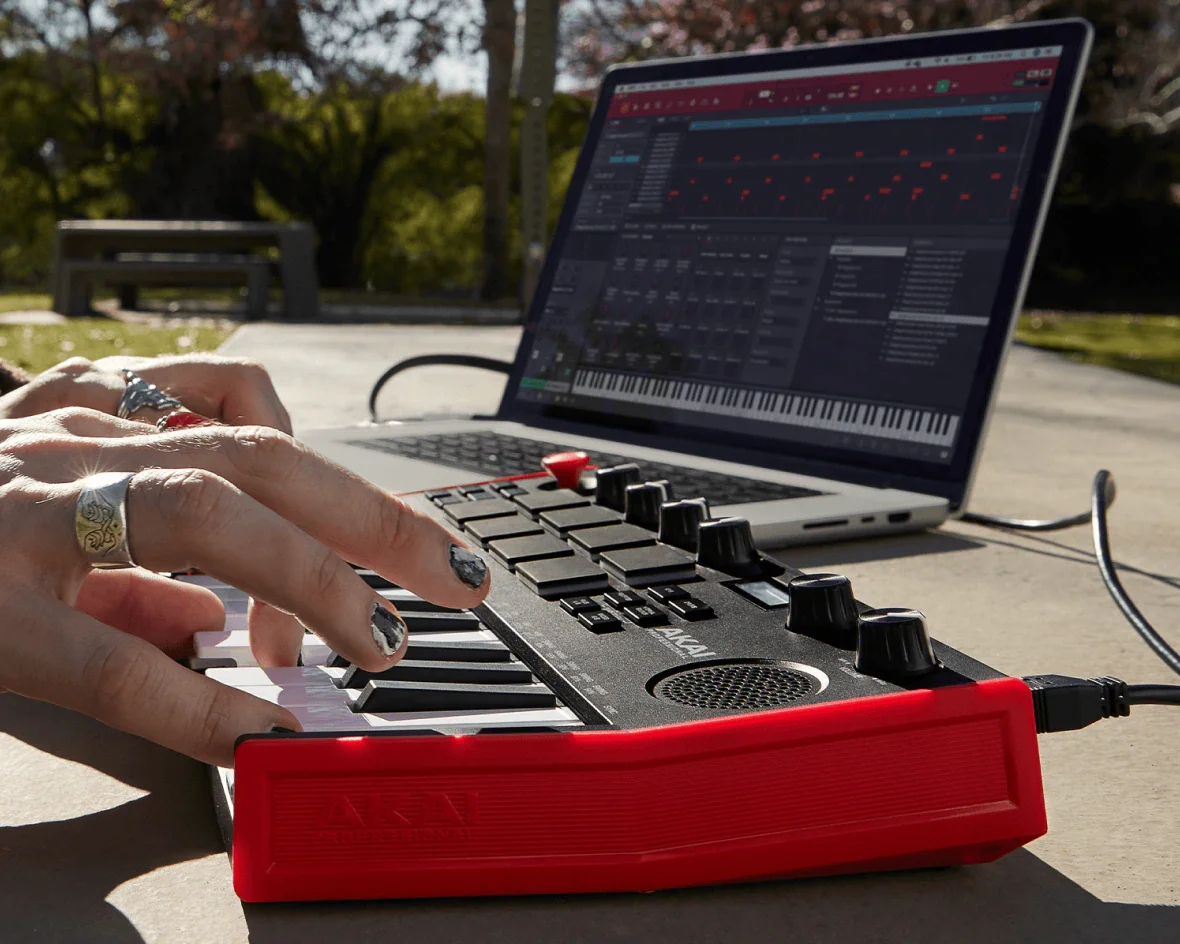
Akai publishes a 12.5-by-7-by-2.3-inch body and a 1.9-pound weight. At 12.5 inches, the body is narrower than the 17.76-inch original Mini Plus. The compact measurement is a first screen only: a sustain plug, USB lead, hands and a nearby laptop may extend the space needed. The product-page images show the controller in laptop and travel contexts; those computers, cables and bags are not package claims.
The Play's own sound engine and speaker distinguish it from the standard MPK Mini MK3, whose support FAQ describes a computer-based MIDI workflow and no self-generated sound. The standard Mini MK3's FAQ names a USB-A-to-USB-B cable and gives its own dimensions; that information should not be borrowed for the Play, whose exact page does not identify the connector shape. The models also remain distinct from the 37-key Mini Plus family.
Who should keep it on the shortlist?
Consider the Play MK3 when an onboard sound source, speaker/headphone output, pressure-sensitive pads and a light, narrow body matter more than a long key range or direct DIN. It can support a self-contained practice routine and a USB-MIDI computer workflow, but the chosen setup must account for four AA batteries or USB bus power. Check the seller's exact model suffix, cable and battery policy, and verify the headphone connection and current manual before relying on it.
Pass over it if 37 or more keys, a confirmed USB-C device plug, direct five-pin MIDI Out or verified keyboard aftertouch is non-negotiable. This is a source-based assessment, not a hands-on review: it makes no claim about the speaker's tonal quality, battery endurance in use or key action. The play/sound capability is the meaningful difference, not an assumed advantage in sound or feel.
Key specifications
Key details at a glance
| Keys | 25 |
|---|---|
| Manufacturer's keybed description | Velocity sensitive mini keys |
| Width | 12.5 in |
| Pads | 8 |
| Velocity-sensitive pads | Yes |
| Pressure-sensitive pads | Yes |
| USB bus-powered | Yes |
| Assignable pedal input | Yes |
| Depth | 7 in |
Use the exact model’s instructions for operating limits, supplied equipment and version differences.
Sources for this review
Sources for this assessment
Start with your setup, not a headline feature
Use the finder to combine key-count, connection, control and desk-fit requirements. Unverified specifications are never treated as a match.