
Your needs, this model
Does it fit your priorities?
Does the VI61 satisfy a 61-key physical minimum?
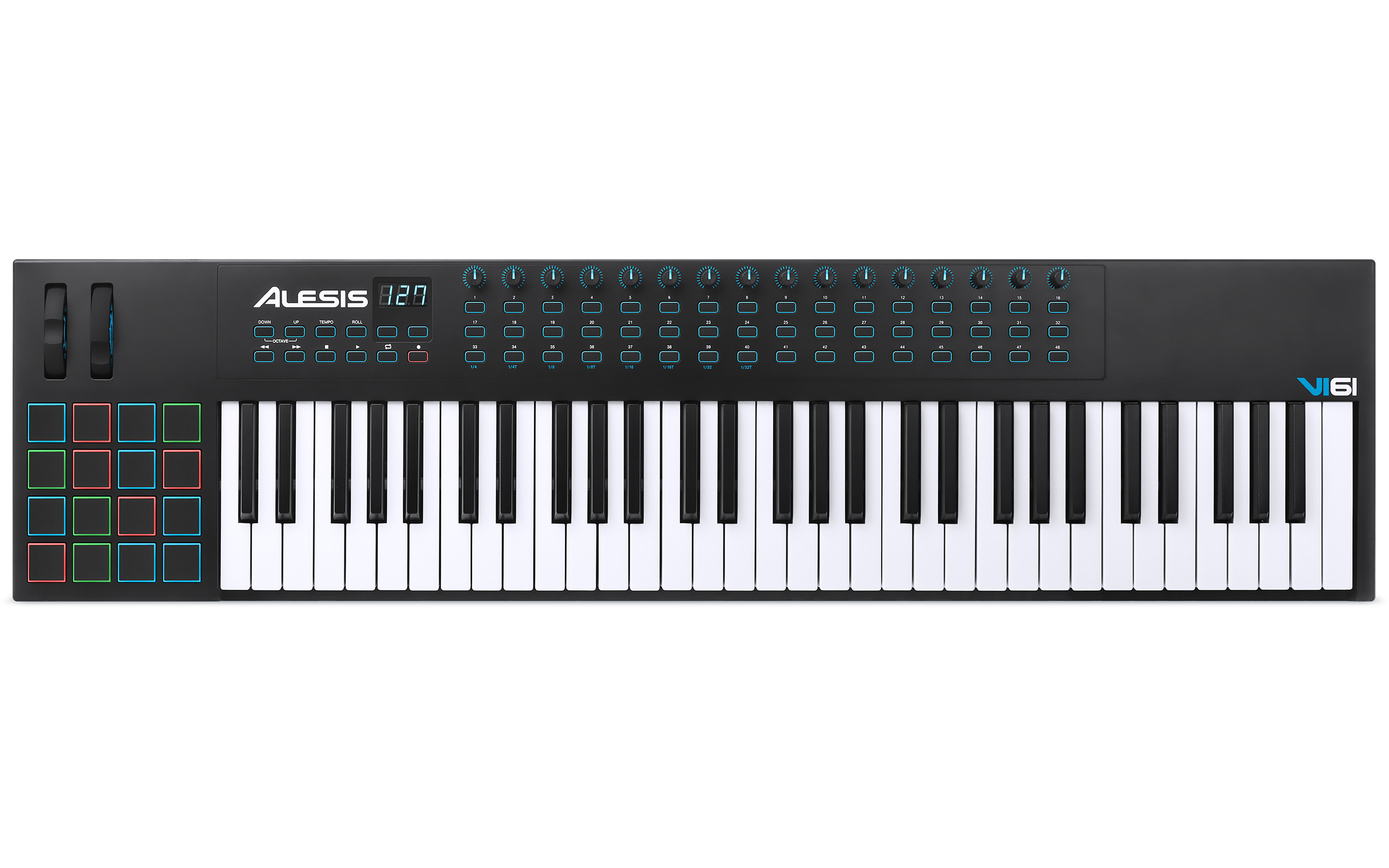
Yes. The VI61 product page and its own guide specify 61 full-size, semi-weighted velocity-sensitive keys with aftertouch. Octave shift expands the MIDI-note range but does not change the number of keys available simultaneously; the listed 44.1-inch width is also a substantial footprint to measure against your playing surface.
Explore this need in the finder →Can the VI61 control a five-pin MIDI module on a computer-free setup?
The VI61 guide documents direct five-pin MIDI Out and a hardware-module setup. In that arrangement Alesis specifies a separately sold 9 V DC, 500 mA, center-positive adapter (or the documented USB-charger alternative); budget the module and its own audio/monitoring path as well.
Explore this need in the finder →Does the VI61 have a verified USB-C connection or a sound engine?
The manual names a USB port without identifying its connector shape, so a USB-C requirement is not verified. The manufacturer presents VI61 as a USB/MIDI controller for computer software or an external sound module; the reviewed page/manual do not specify onboard instrument sounds or an audio output.
Explore this need in the finder →The Alesis VI61 earns its place in a comparison when the job genuinely needs a 61-key physical bed and a bank of direct controls—not simply because a larger number sounds more future-proof. Its own page and v1.1 guide describe full-size, semi-weighted keys with velocity response and aftertouch, plus 16 pads, 16 assignable knobs, 48 assignable buttons and a five-pin MIDI output. The same guide also documents USB bus power, an optional standalone power arrangement and published body dimensions, so it is possible to assess its setup and workspace more precisely than a model with missing measurements.
Range and control count are tied to a wide shell
With 61 physical keys, the VI61 supports a wider simultaneous note span than the VI25 and VI49 siblings. Octave buttons move the active range through the MIDI note set, but the practical difference between family sizes is the number of keys available at the same time. Someone playing broad two-handed parts may prefer that extra range; someone mainly entering a short synth phrase may be carrying a longer keyboard without using the extra keys. Alesis describes the action as semi-weighted and the keys as full-size; the manual confirms aftertouch but does not specify its transmission type or measure key width. This is not documented as a graded hammer-action piano bed. The control surface scales with the keys: VI61 has 16 assignable rotary knobs and 48 assignable buttons, along with 16 velocity-sensitive RGB pads and six transport buttons. The manual assigns controls for tempo and pad-roll behavior, including time-division, gate and swing adjustments. The pads can trigger notes or samples, and the editor can configure MIDI messages; the guide does not establish pressure sensitivity beyond the stated velocity response. This high button count is useful when you will assign and remember a control map, but it is not a substitute for a DAW's own software mapping support. The controller also includes pitch and modulation wheels and a compact three-digit display.Two MIDI routes, with power and audio outside the keyboard
The computer route uses USB for MIDI and bus power. The VI61 manual calls for a standard USB cable but does not name the device-end socket type. A USB-C-only requirement therefore remains unverified; check the exact unit or the seller's cable description instead of inferring a connector from the generic USB wording. A configured software instrument supplies the notes' sound, and its computer or interface must still connect to speakers or headphones. For external gear, the VI61 has a five-pin MIDI Out and a 1/4-inch TS sustain input. Alesis's guide describes a computer-free module path and specifies an optional 9 V DC, 500 mA, center-positive adapter, with a standard USB charger also described as an alternative supply. Neither is in the listed box contents. The external module must have its own power and audio output; the VI61 sends control data and is not documented as an audio generator. The guide also says that computer MIDI can be routed over USB through the VI61 to hardware on its MIDI Out, so USB-hosted and DIN-controlled gear can be used in a described arrangement. The exact cable, MIDI channel and module routing still need to be checked against the intended setup.Use the printed dimensions as a real fit boundary
The model guide reports a 44.1-inch width, 12.4-inch depth, 4.5-inch height and 13-pound weight. A 61-key unit plus pads and controls can dominate a desk; include the space for hands, cable turns and stand brackets rather than measuring only an empty shelf. These are manufacturer body dimensions, not a claim that the controller will fit a particular table or that the keys' spacing has been measured. If a hard width cap is below 44.1 inches, this specific configuration fails it; a smaller VI sibling or another model should be assessed instead.Current software support needs a separate check
Alesis's support pages checked November 3, 2026 list VI61 hardware as Supported in both the Windows 11 and macOS 14 tables. The software-editor tables on those same pages list VI Editor as Not Supported. This is an important distinction: the hardware row concerns connection and MIDI communication on those named OS versions, while the editor row concerns the utility used to customize the control surface. Neither table promises compatibility with a later operating-system release, a particular DAW script or an older bundled license. The product page describes Ableton Live Lite and Xpand!2 downloads, but current redemption and host requirements should be verified for the exact offer.Compared with the VI49, VI61 adds 12 physical keys, four assignable knobs and 12 buttons, while the published shell grows from 37.6 to 44.1 inches wide and from 11 to 13 pounds. The VI25 makes the opposite space/range trade: only 25 full-size keys but the same general pads, wheels and DIN architecture. That is a meaningful family comparison, not a test result. This assessment uses Alesis's VI61 page, exact guide and support records; no hands-on use, sound-quality judgment, seller package inspection or current stock claim is implied.
Key specifications
Key details at a glance
| Keys | 61 |
|---|---|
| Manufacturer's keybed description | Full-size semi-weighted keys (manufacturer wording) |
| Width | 44.1 in |
| Pads | 16 |
| Velocity-sensitive pads | Yes |
| 5-pin MIDI Out | Yes |
| USB bus-powered | Yes |
| Assignable pedal input | Yes |
| Keyboard channel aftertouch | Yes |
| 5-pin MIDI In | No |
| Depth | 12.4 in |
| 5-pin MIDI outputs | 1 |
Use the exact model’s instructions for operating limits, supplied equipment and version differences.
Sources for this review
Sources for this assessment
Start with your setup, not a headline feature
Use the finder to combine key-count, connection, control and desk-fit requirements. Unverified specifications are never treated as a match.