
Your needs, this model
Does it fit your priorities?
Can the 25-key Air fit a narrow workstation and still work wirelessly?
KORG lists a 15.55-inch body width and Bluetooth Low Energy MIDI, with wireless power from two AA batteries. USB Type-B is the wired alternative. The 25-key model uses mini keys and has no separate pedal jack or documented DIN output; check the target host/app and allow cable and hand clearance beyond the body measurement.
Explore this need in the finder →Does the Air-25 have direct five-pin MIDI Out for a hardware synth?
KORG's reviewed US specifications list USB Type-B and Bluetooth MIDI but no 5-pin MIDI Out. The joystick/sustain control and Bluetooth connection are not a direct DIN path; use a separately documented host/interface arrangement or choose a controller with a verified DIN output.
Explore this need in the finder →Is its computer connection USB-C?
No. KORG specifies USB Type-B for wired computer MIDI. Bluetooth is a separate wireless mode. A USB-C computer may require a suitable cable or adapter, and the connector alone does not establish OS, app or DAW compatibility.
Explore this need in the finder →The KORG microKEY Air-25 is a compact, velocity-sensitive mini-key MIDI controller with two distinct ways to reach a host: a wired USB Type-B connection or Bluetooth Low Energy MIDI. The small range and the 25-key model's joystick/arpeggiator layout make it a different proposition from the 37-, 49- and 61-key Air versions. This assessment is based on KORG's current US product and specification pages and the Air-25 owner's manual, not on hands-on testing.
What the 25-key version does differently
KORG calls its keyboard a Natural Touch mini-keyboard. The manual documents velocity-sensitive keys and eight velocity curves, with a Const setting that makes every note send the selected fixed velocity value. That gives a host application a useful way to adapt MIDI response, but it does not turn the short mini-key layout into a piano-sized keybed or establish which touch a particular player will prefer. There are 25 physical notes; octave buttons and transpose settings let the controller address notes beyond that span, but octave shifting is not the same as having additional keys under both hands.
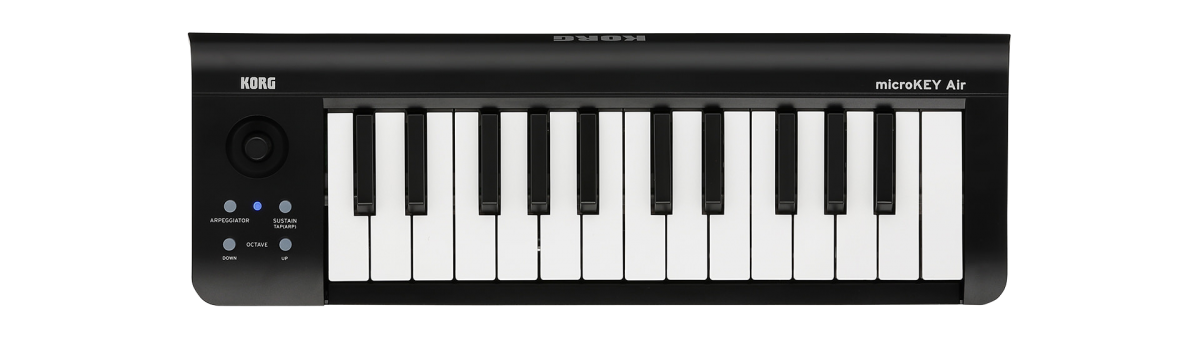
The distinctive control surface is concentrated at the left end: a joystick, arpeggiator button, sustain/TAP button and octave-shift buttons. The joystick can send pitch-bend and modulation-related data; its behavior also interacts with the arpeggiator. The sustain/TAP button provides a damper-style MIDI control and tempo tap, rather than a socket for a separate foot pedal. KORG's specification describes a ±4-octave shift range for this model. This control set is a meaningful size-specific difference from the three longer Air keyboards, which use separate pitch and modulation wheels and provide an assignable switch jack.
Wired USB and wireless MIDI are separate setups
For a desk setup, USB Type-B connects the microKEY Air-25 to a computer and supplies bus power. It is not USB-C. A computer that has only USB-C may need an appropriate cable or adapter; the connector shape is not a compatibility guarantee for a particular host, cable or DAW. KORG's manual instructs the user to select the controller in the host software's MIDI settings. The keyboard sends control data; the computer, app or another instrument must generate the sound and provide an audio-monitoring path.
For wireless use, the mode switch selects Bluetooth MIDI and the unit runs on two AA batteries. KORG's Bluetooth connection guide, published in March 2026, explains that app-specific pairing and MIDI-port selection are part of setup, and directs users to KORG's current OS support information rather than promising compatibility with every app. The guide says Windows wireless use requires KORG's BLE-MIDI driver. Bluetooth operation is not a second output that can be assumed to mirror USB at the same time: KORG describes USB and wireless as alternate mode-switch positions. If a tablet or phone is the intended host, check the exact operating system, app, Bluetooth MIDI support and any wired adapter route before choosing a connection method.
Space, battery claims and documented limits
The published body is 15.55 inches wide, 5.16 inches deep and 2.05 inches high; KORG lists the Air-25 at 670 g. Those are bare-body dimensions. The finder can screen it at its smallest 16-inch width setting, but a real desk needs extra space for hands and a cable bend. The Air-25 is the only Air configuration in this set that fits that width, and it trades the longer siblings' key range and pedal socket for a shorter footprint.
Battery duration deserves caution. KORG's current specification page describes about 30 hours, while the 2024 owner's manual says approximately 20 hours when using alkaline batteries. The product page separately describes about a month at an average hour of use per day. Because those statements are not identical conditions or values, treat runtime as an estimate and plan a spare pair rather than scheduling around a precise figure. The manual permits alkaline or nickel-metal-hydride AA batteries; the current included-items list names a USB cable and software bundle code, not batteries. Confirm the exact seller package.
The reviewed specifications list USB and the Air-25's surface controls, but no 5-pin DIN MIDI output, audio output, built-in sound engine or separate pedal jack. Therefore it is not a direct hardware-MIDI keyboard in this assessment. A USB host or compatible Bluetooth MIDI host is part of the sound-producing setup. The included-software listing is not a promise that a specific license will transfer with a used or opened offer.
Who should compare it—and what to verify
Consider the Air-25 when you need a short 25-note range, want the option of Bluetooth MIDI, and value its joystick/arpeggiator controls more than a separate pedal input or the longer Air models' wheels. Compare the Air-37 if 37 mini keys and a pedal jack matter more than the 25's arpeggiator-focused panel; the larger boards add more physical range but also widen the playing footprint. The nanoKEY Fold is a separate 25-button USB-C/TRS-DIN product, not a Bluetooth Air equivalent; its note input and signal path differ.
Before ordering, check that the offer is specifically the microKEY Air-25 rather than the non-Air microKEY-25, confirm the cable and battery situation, and consult KORG's current Bluetooth OS-support page and the target app's MIDI instructions. No retail SKU, live price, stock status or seller package is established by the maker pages reviewed here. The evidence supports the documented controller and setup choices, not a promise of wireless reliability in a particular room or a personal feel recommendation.
Primary sources: KORG microKEY Air product page, KORG current specifications and FAQ, KORG Air-25 Owner's Manual download page and the March 2026 Bluetooth MIDI Connection Guide.
Key specifications
Key details at a glance
| Keys | 25 |
|---|---|
| Manufacturer's keybed description | Natural Touch mini keys (KORG description) |
| Width | 15.55 in |
| Pads | 0 |
| Velocity-sensitive pads | No |
| Pressure-sensitive pads | No |
| 5-pin MIDI Out | No |
| Computer connection | USB Type-B |
| USB bus-powered | Yes |
| Assignable pedal input | No |
| 5-pin MIDI In | No |
| Depth | 5.16 in |
| 5-pin MIDI outputs | 0 |
Use the exact model’s instructions for operating limits, supplied equipment and version differences.
Sources for this review
Sources for this assessment
- KORG Computer Gear catalogue (US)
- KORG microKEY Air product page (US)
- KORG microKEY Air current specifications and FAQ (US)
- KORG microKEY Air support downloads (US)
- KORG microKEY Air-25 / microKEY-25 Owner's Manual (English section)
- KORG microKEY Air-37/49/61 / microKEY-37/49/61 Owner's Manual (English section)
- KORG Bluetooth MIDI Connection Guide, English, published March 2026
Start with your setup, not a headline feature
Use the finder to combine key-count, connection, control and desk-fit requirements. Unverified specifications are never treated as a match.