
Your needs, this model
Does it fit your priorities?
What extra physical range does the 37-key Air give over the smaller Air models?
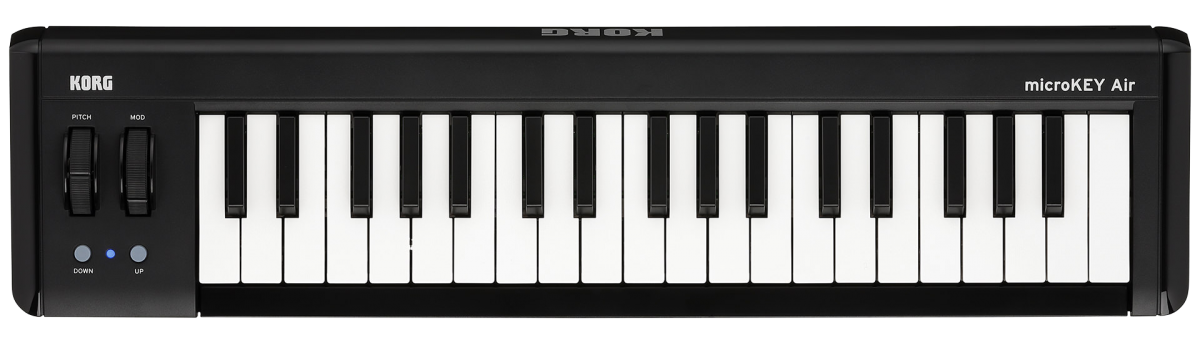
KORG specifies 37 velocity-sensitive mini keys in a 22.24-inch body. Its octave-shift range is -4 to +4; the extra physical notes are available at once, unlike relying on octave shifts on a shorter board. It remains a mini-key controller rather than a full 88-note piano range.
Explore this need in the finder →Can it send MIDI to external hardware over a direct DIN output?
KORG's reviewed specifications list USB Type-B and, on the 37/49/61 models, an assignable pedal-switch jack. They do not document MIDI DIN Out. The pedal jack is not a note-output port, so this model does not meet a direct five-pin requirement on current evidence.
Explore this need in the finder →Is USB-C required for the computer connection?
The Air uses a USB Type-B connector for wired MIDI, not USB-C. Bluetooth Low Energy MIDI is a separate mode using two AA batteries. A Type-C host may need an appropriate cable or adapter; check current OS and app support before relying on wireless use.
Explore this need in the finder →The KORG microKEY Air-37 is a 37-key mini-key MIDI controller for a player who wants more physical range than the 25-key Air without moving to a 49- or 61-key body. Its two host routes—USB Type-B or Bluetooth Low Energy MIDI—are useful only when the computer, tablet or phone and its music application can accept the corresponding MIDI connection. This is a source-based assessment of KORG's US model information and owner documentation, not a hands-on review.
Why the 37-key configuration is distinct
KORG identifies all four Air sizes as Natural Touch mini-keyboards, and the owner's manual describes velocity-sensitive keys with eight response curves plus a Const setting for a selected fixed value. The 37-key span gives more notes at once than the Air-25, while remaining shorter than the 49- and 61-key versions. It is still a mini-key instrument, not a full-size keybed; octave controls extend the available MIDI range but do not replace keys when a part needs both hands to stay in one position.
Compared with the 25-key Air, this model has dedicated pitch-bend and modulation wheels and an assignable switch jack for a separate footswitch or damper pedal. KORG documents an octave-shift range of ±4 for both Air-25 and Air-37; the longer 49- and 61-key variants use ±3. These are practical control differences, not just alternate colors or an interchangeable SKU. The Air-37's panel is therefore better suited to a player who wants separate wheel gestures and a pedal input; the 25-key model instead groups joystick, arpeggiator, sustain/TAP and octave controls into its smaller left section.
Two host routes, with different power needs
The wired route connects USB Type-B to a computer and takes bus power over USB. KORG's manual tells the user to select the microKEY Air/microKEY MIDI port in the host application. This is a USB-MIDI controller, not an audio interface or sound module; plan for a software instrument or external tone generator and a separate way to monitor audio. The connection is Type-B rather than USB-C, so do not assume a modern computer's port can connect without the right cable or adapter.
The wireless route switches to Bluetooth MIDI and uses two AA cells rather than USB power. KORG's March 2026 connection guide describes host-side pairing and app MIDI-port selection, and tells users to check KORG's live OS-support page for current requirements. It specifically says Windows Bluetooth MIDI requires the KORG BLE-MIDI driver. Bluetooth operation and USB operation are alternate mode-switch settings; the reviewed manual does not promise simultaneous USB-host and Bluetooth control. The music app remains responsible for receiving MIDI, and a particular host may require its own configuration.
KORG's current support page lists the Air-37 model alongside Air-25, Air-49 and Air-61. Do not read that family listing as a guarantee for every third-party Bluetooth implementation. If the wireless path is central to the purchase, check the target device, operating system, app support and driver before relying on it. If you prefer a wired setup, verify that the exact USB cable reaches the computer and that the host has adequate USB power.
Footprint, runtime and the sound path
The Air-37 measures 22.24 inches wide, 5.47 inches deep and 2.13 inches high in KORG's current table; its metric weight is 1.0 kg. This width clears a 22.25-inch numeric screen, but the 0.01-inch margin over the published body does not allow room for a cable, hands or a stand lip. For a 49-key step-up, compare the Air-49 at 27.91 inches; for a tighter desk, the Air-25 is 15.55 inches wide but has fewer physical keys and a different control panel.
The Air battery-life figures need a reality check. The current KORG specification page gives approximately 30 hours and the product page describes about one month at an average hour per day, while the 2024 manual says approximately 20 hours on alkaline batteries. These are not identical stated conditions, so the evidence does not justify a precise guaranteed runtime. The manual permits alkaline or NiMH AA batteries. KORG's current included-items text lists a USB cable and software bundle code; it does not establish that batteries or a pedal will be in a given seller's box.
The maker's reviewed connector information lists USB Type-B and the 37-key model's assignable switch jack, but no 5-pin DIN MIDI output or audio output. A pedal jack is not MIDI OUT. If an external synth needs 5-pin DIN from the keyboard, this evidence does not support the Air-37 as a direct solution; choose a controller with a documented DIN route or verify a separate interface arrangement. The Air-37 does not make sound by itself.
Fit and buying checks
Compare the Air-37 when 37 simultaneous notes, velocity-sensitive mini keys, pitch/mod wheels, and a pedal input are useful but a 49-key footprint feels unnecessarily long. Compare it with the Air-25 for the arpeggiator/joystick alternative and with the Air-49 if the additional octave is important. The Keystage-49 is a very different 49-key KORG: it has a semi-weighted full-size keybed, USB-B, audio-interface functions and direct DIN, and occupies a larger footprint.
Check the model suffix carefully: KORG also has non-Air microKEY sizes, and USB/Bluetooth and battery descriptions must not be transferred to those siblings without their own review. Confirm the actual USB cable, a suitable pedal if you need one, the current OS/app connection requirements and the exact software terms in the seller's package. The sources reviewed do not identify an exact retail SKU or current offer, price or stock.
Primary sources: KORG microKEY Air product page, KORG current specifications and FAQ, KORG Air-37/49/61 Owner's Manual download page and the March 2026 Bluetooth MIDI Connection Guide.
Key specifications
Key details at a glance
| Keys | 37 |
|---|---|
| Manufacturer's keybed description | Natural Touch mini keys (KORG description) |
| Width | 22.24 in |
| Pads | 0 |
| Velocity-sensitive pads | No |
| Pressure-sensitive pads | No |
| 5-pin MIDI Out | No |
| Computer connection | USB Type-B |
| USB bus-powered | Yes |
| Assignable pedal input | Yes |
| 5-pin MIDI In | No |
| Depth | 5.47 in |
| 5-pin MIDI outputs | 0 |
Use the exact model’s instructions for operating limits, supplied equipment and version differences.
Sources for this review
Sources for this assessment
- KORG Computer Gear catalogue (US)
- KORG microKEY Air product page (US)
- KORG microKEY Air current specifications and FAQ (US)
- KORG microKEY Air support downloads (US)
- KORG microKEY Air-25 / microKEY-25 Owner's Manual (English section)
- KORG microKEY Air-37/49/61 / microKEY-37/49/61 Owner's Manual (English section)
- KORG Bluetooth MIDI Connection Guide, English, published March 2026
Start with your setup, not a headline feature
Use the finder to combine key-count, connection, control and desk-fit requirements. Unverified specifications are never treated as a match.