
Your needs, this model
Does it fit your priorities?
What extra physical range does the 49-key Air give over the smaller Air models?
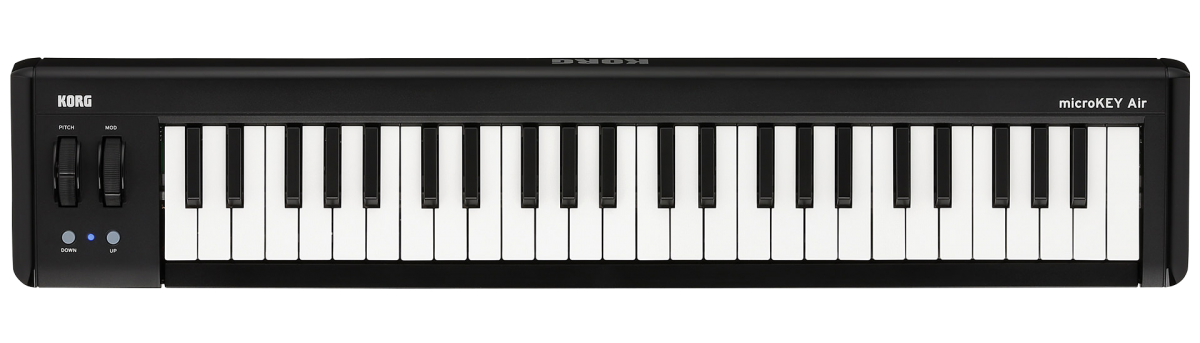
KORG specifies 49 velocity-sensitive mini keys in a 27.91-inch body. Its octave-shift range is -3 to +3; the extra physical notes are available at once, unlike relying on octave shifts on a shorter board. It remains a mini-key controller rather than a full 88-note piano range.
Explore this need in the finder →Can it send MIDI to external hardware over a direct DIN output?
KORG's reviewed specifications list USB Type-B and, on the 37/49/61 models, an assignable pedal-switch jack. They do not document MIDI DIN Out. The pedal jack is not a note-output port, so this model does not meet a direct five-pin requirement on current evidence.
Explore this need in the finder →Is USB-C required for the computer connection?
The Air uses a USB Type-B connector for wired MIDI, not USB-C. Bluetooth Low Energy MIDI is a separate mode using two AA batteries. A Type-C host may need an appropriate cable or adapter; check current OS and app support before relying on wireless use.
Explore this need in the finder →The KORG microKEY Air-49 is the middle-size model in the Air family: it puts 49 velocity-sensitive mini keys in a published 27.91-inch body and adds pitch and modulation wheels plus an assignable pedal switch jack. It offers the same broad USB Type-B and Bluetooth Low Energy MIDI routes as the other Air sizes, with a different balance of key span, controls and desk space. This assessment is drawn from KORG's US product/specification pages and manual, not a personal use test.
What you gain at 49 keys
The extra physical range over the Air-37 matters when a part needs more notes available without repeated octave changes, but 49 keys remain a compact playing span rather than an 88-note piano range. KORG describes the keybed as its Natural Touch mini-keyboard; the manual documents velocity response with eight curves and a Const setting that sends a chosen fixed velocity. The sources do not characterize it as weighted, nor do they establish a subjective feel preference. This is a size decision and a mini-key action decision at once.
The Air-49 shares the 37- and 61-key siblings' separate pitch-bend and modulation wheels and 1/4-inch assignable switch jack for an optional pedal. KORG's specifications give the 49- and 61-key sizes a ±3-octave shift range, versus ±4 for Air-25/37. That difference is worth noting if you use the front-panel octave controls often. The Air-25 is not simply a shorter version: it substitutes a joystick, arpeggiator and sustain/TAP buttons for the wheels/pedal jack, while Air-37 has a shorter 37-key span and ±4 shift range.
Wired host and Bluetooth setups
For wired operation, the USB Type-B connector links the keyboard to a computer and carries USB bus power. KORG's manual explains that the selected host application needs to recognize the microKEY Air/MIDI port. The Air-49 is a controller, not a sound source; software or another instrument makes the sound, and monitoring is handled elsewhere. USB Type-B is not USB-C. If the computer has a different port, confirm the appropriate cable or adapter and the host's connection behavior rather than assuming the connector name proves compatibility.
For wireless control, set the mode switch to WIRELESS and use two AA batteries. KORG's Bluetooth MIDI Connection Guide was updated in March 2026; it describes the host-side pairing/application process and points readers to current OS support rather than promising every version will work. The guide notes that the KORG BLE-MIDI Driver is required for Windows wireless use. Bluetooth MIDI depends on the host app's ability to select the device and receive MIDI. The manual positions Bluetooth and USB as alternate modes, so treat them as separate setups, not simultaneous outputs. The battery-operated mode is convenient for a cable-light rig but makes battery condition part of setup planning.
Width, weight and evidence conflicts
KORG's current dimensions for the Air-49 are 27.91 inches wide, 5.47 inches deep and 2.13 inches high. The supported metric weight is 1.4 kg. There is a discrepancy in KORG's own materials: the current specification table pairs 1.4 kg with 2.21 lb, but the 2024 manual gives the same 1.4 kg as 3.09 lb. The pound values do not agree with each other or with the metric conversion. I use the common manufacturer metric value and do not treat 2.21 lb as a reliable weight figure. This does not affect the model's assessed key count or width.
At the finder’s quarter-inch increments, the 27.91-inch body first clears a 28-inch maximum; a 27.75-inch cap is too narrow. Measure the work surface separately for plug clearance, hands, stand support and any neighboring equipment. If 28 inches is not available, the 37-key Air is 22.24 inches wide; if more notes are essential and the desk allows it, the 61-key Air is 33.46 inches.
The battery-life information also differs: the current specification page lists approximately 30 hours, the page's prose uses an average-hour-per-day month estimate, and the 2024 manual says approximately 20 hours on alkaline cells. The sources do not give one unambiguous condition that reconciles these figures. Plan around replaceable AA batteries and avoid treating any one runtime number as guaranteed. The manual permits alkaline or NiMH batteries; check the seller's exact package for included cells and the separate pedal.
What this model does not provide
KORG's reviewed specification lists USB and an assignable switch jack for the 49-key model. It does not document direct 5-pin MIDI In/Out, audio output or a built-in sound engine. If an external MIDI module is the destination, this controller's pedal socket is not a substitute for MIDI DIN. It may still serve a hardware rig through a computer or separate MIDI interface, but the required extra routing is not part of the documented direct setup here. The free software bundle mentioned by KORG also should not be assumed to transfer to a used unit or a seller's opened package.
Who should compare it
Compare Air-49 if you want a compact 49-note range, a choice of wired or wireless MIDI, and wheel gestures plus an optional pedal input, and if mini keys suit your work. The Air-37 is narrower and provides a ±4 octave-shift range, while the Air-61 gives a longer span at a wider body. A different 49-key controller such as KORG's Keystage-49 adds semi-weighted full-size keys and direct DIN/audio-interface functions, but its footprint and setup are not equivalent.
Before ordering, verify Air-49 rather than a non-Air microKEY-49, test your intended host and app against current KORG Bluetooth support, confirm the USB cable and pedal are included if needed, and check seller license/return terms. No live price, stock or exact retailer SKU is established by the manufacturer information reviewed here.
Primary sources: KORG microKEY Air product page, KORG current specifications and FAQ, KORG Air-37/49/61 Owner's Manual download page and the March 2026 Bluetooth MIDI Connection Guide.
Key specifications
Key details at a glance
| Keys | 49 |
|---|---|
| Manufacturer's keybed description | Natural Touch mini keys (KORG description) |
| Width | 27.91 in |
| Pads | 0 |
| Velocity-sensitive pads | No |
| Pressure-sensitive pads | No |
| 5-pin MIDI Out | No |
| Computer connection | USB Type-B |
| USB bus-powered | Yes |
| Assignable pedal input | Yes |
| 5-pin MIDI In | No |
| Depth | 5.47 in |
| 5-pin MIDI outputs | 0 |
Use the exact model’s instructions for operating limits, supplied equipment and version differences.
Sources for this review
Sources for this assessment
- KORG Computer Gear catalogue (US)
- KORG microKEY Air product page (US)
- KORG microKEY Air current specifications and FAQ (US)
- KORG microKEY Air support downloads (US)
- KORG microKEY Air-25 / microKEY-25 Owner's Manual (English section)
- KORG microKEY Air-37/49/61 / microKEY-37/49/61 Owner's Manual (English section)
- KORG Bluetooth MIDI Connection Guide, English, published March 2026
Start with your setup, not a headline feature
Use the finder to combine key-count, connection, control and desk-fit requirements. Unverified specifications are never treated as a match.